
Virginia Workers' Compensation Claims Guide for Injured Employees

A workplace injury can turn a normal shift into a paperwork problem, a medical problem, and a paycheck problem all at once. Virginia’s workers’ compensation system is meant to help injured employees get medical care and wage benefits without having to prove that the employer was at fault.
This guide focuses on Virginia law, not Florida law, because the claim rules, deadlines, and agencies are different from state to state. It is for general information only and is not legal advice.

What Virginia workers’ compensation covers
Workers’ compensation generally covers injuries and occupational diseases that arise out of and occur in the course of employment. In plain English, the injury must have a real connection to the job.
Common examples include:
A delivery driver hurt in a vehicle crash while making deliveries
A warehouse employee injured while lifting freight
A healthcare worker who develops a covered occupational illness
A construction worker injured in a fall on a jobsite
A restaurant worker burned during food preparation
Virginia uses a no-fault system for many workplace injuries. That means an employee usually does not have to prove the employer did something wrong. At the same time, not every injury at work automatically qualifies. The details matter, including where the injury happened, what the employee was doing, and whether the injury came from a specific work-related risk.
Most Virginia employers with more than two employees must carry workers’ compensation insurance. Coverage can apply to full-time, part-time, seasonal, and other employees, depending on the work relationship and facts.
Report the injury as soon as possible
The first practical step is simple: tell the employer right away. Virginia law generally requires an injured worker to give notice to the employer within 30 days of the accident. Waiting can create problems, especially if the employer or insurance carrier argues that the injury was not work-related.
The report does not need to be dramatic. It should be clear and specific.
Include:
The date and time of the injury
Where it happened
What task was being performed
The body parts injured
Names of any witnesses
Whether medical care is needed
If possible, report the injury in writing and keep a copy. A text message, email, or written incident report can help confirm when notice was given.
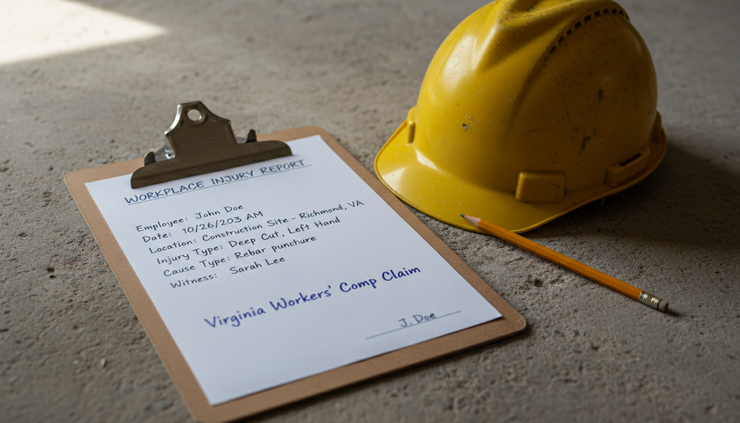
File a claim with the Virginia Workers’ Compensation Commission
Reporting the injury to an employer is not the same as filing a formal claim. In Virginia, injured employees generally must file a claim with the Virginia Workers’ Compensation Commission within two years of the accident. For some occupational disease claims, different timing rules may apply.
This deadline is one of the most important parts of Workers' Compensation in Virginia. An employer’s insurance company may pay some bills or wage benefits early on, but that does not always protect the employee’s legal rights. Filing with the Commission helps preserve the claim.
A claim usually identifies:
The injured worker
The employer
The date of injury
The type of injury
The benefits being requested
If a claim is denied, delayed, or disputed, the Commission may schedule further proceedings. The process can involve medical records, wage records, witness statements, and testimony.
Get medical treatment through the proper channels
Medical care is often the center of a workers’ compensation claim. Virginia law generally allows the employer or insurance carrier to provide a panel of physicians in many accepted claims. The injured employee then chooses a doctor from that panel.
Once an authorized treating physician is selected, that doctor’s opinions can strongly affect the claim. The doctor may address:
Work restrictions
Whether the injury is job-related
Whether the employee can return to regular duty
Whether light duty is appropriate
Whether specialist care or therapy is needed
Employees should describe symptoms honestly and fully. They should also follow reasonable medical instructions. Missed appointments, inconsistent reports, or returning to activities beyond medical restrictions can complicate a claim.

Understand the benefits that may be available
Virginia workers’ compensation benefits can include several types of support, depending on the injury and medical evidence.
Medical benefits
Covered medical benefits may include authorized doctor visits, hospital care, prescriptions, physical therapy, diagnostic testing, and other treatment that is reasonable, necessary, and related to the work injury.
Wage loss benefits
If an authorized doctor keeps the employee out of work, wage replacement benefits may be available. If the employee can work only light duty and earns less than before, partial wage benefits may apply.
Virginia wage benefits are usually based on the employee’s average weekly wage and are subject to state minimums and maximums. There is also a waiting period before wage benefits begin, and longer disability periods can affect whether the first days are paid.
Permanent impairment benefits
If the injury causes lasting impairment to certain body parts, permanent partial disability benefits may be available. These benefits often depend on a doctor’s impairment rating and the body part involved.
Vocational rehabilitation
Some injured employees cannot return to their old jobs because of permanent restrictions. Vocational rehabilitation may help with job placement, retraining, or returning to suitable work within medical limits.
Watch for common claim problems
Many claims move forward without a major fight, but disputes are common. A claim may be denied because the insurance carrier argues that the injury did not happen at work, notice was late, the medical evidence is unclear, or the employee can return to work.
Other problems include:
The employer does not file an accident report
The insurance carrier stops paying benefits
The authorized doctor releases the employee too soon
Light duty is offered but does not match medical restrictions
A preexisting condition is blamed for the symptoms
The employee is pressured to give a recorded statement without preparation
When a dispute affects medical care or wage benefits, speaking with a Workers Comp attorney in Virginia can help clarify options and deadlines.
Be careful with light duty and return-to-work offers
A return-to-work offer must be taken seriously. If a doctor releases an employee to light duty, the employer may offer a modified job. Refusing suitable light duty can put wage benefits at risk.
Before accepting or rejecting the offer, compare the job duties with the written medical restrictions. Pay attention to lifting limits, standing limits, driving restrictions, repetitive motion limits, and required hours.
If the job appears unsafe or outside the doctor’s restrictions, document the issue and ask for clarification. A short written message is better than a verbal disagreement that no one can prove later.

Keep good records from the beginning
A strong claim depends on clear records. Injured employees should keep copies of medical notes, work restriction forms, mileage logs for medical travel, benefit checks, emails, and letters from the insurance carrier.
A simple folder can prevent confusion later. Write down key dates, including the accident date, report date, first medical visit, missed workdays, and any conversations about returning to work.
The best next step after a workplace injury is to act early: report the injury, get appropriate medical care, file with the Virginia Workers’ Compensation Commission, and protect all deadlines. Virginia’s system can provide real support, but only when the claim is handled carefully from the start.


Comments